
Aviator vs Slot Machines: Key Differences
Spribe’s Aviator is a crash game, while a slot machine belongs to a different game format. The main differences are the absence of a bonus round, the player-controlled cash-out, the short round cycle, and the way RTP is presented.
This guide compares those features without treating Aviator as a slot. It explains how the multiplier works, how players exit a round, how the 97% RTP compares with named crash games, and why pacing changes the way the game feels without changing its house edge.
Aviator and slot format
Spribe describes Aviator as a social multiplayer game with an increasing curve that can crash at any time. Aviator launched in early 2019 and has no bonus round.
A slot machine comparison therefore starts with the game structure rather than the theme. Aviator does not present a reel-based bonus feature within the facts available here, so it should be assessed as a crash game and instant game, not as a slot with a different visual design.
- Aviator uses a rising multiplier and a possible crash.
- The player chooses when to cash out before the crash.
- Aviator has no bonus round.
- The game runs in rounds rather than through a bonus-stage sequence.
- The result is fixed before the plane takes off.
That structure gives the player a direct decision in every round. The decision is not whether to enter a bonus round; it is whether to accept a current multiplier or wait for a higher one.
Slot machines and Aviator can both use a stake and a displayed return, but the available facts do not provide one general RTP for slot machines. Slot RTP varies by individual game, so a fair comparison must use the stated Aviator figure and the RTP figures published for named crash-game alternatives.
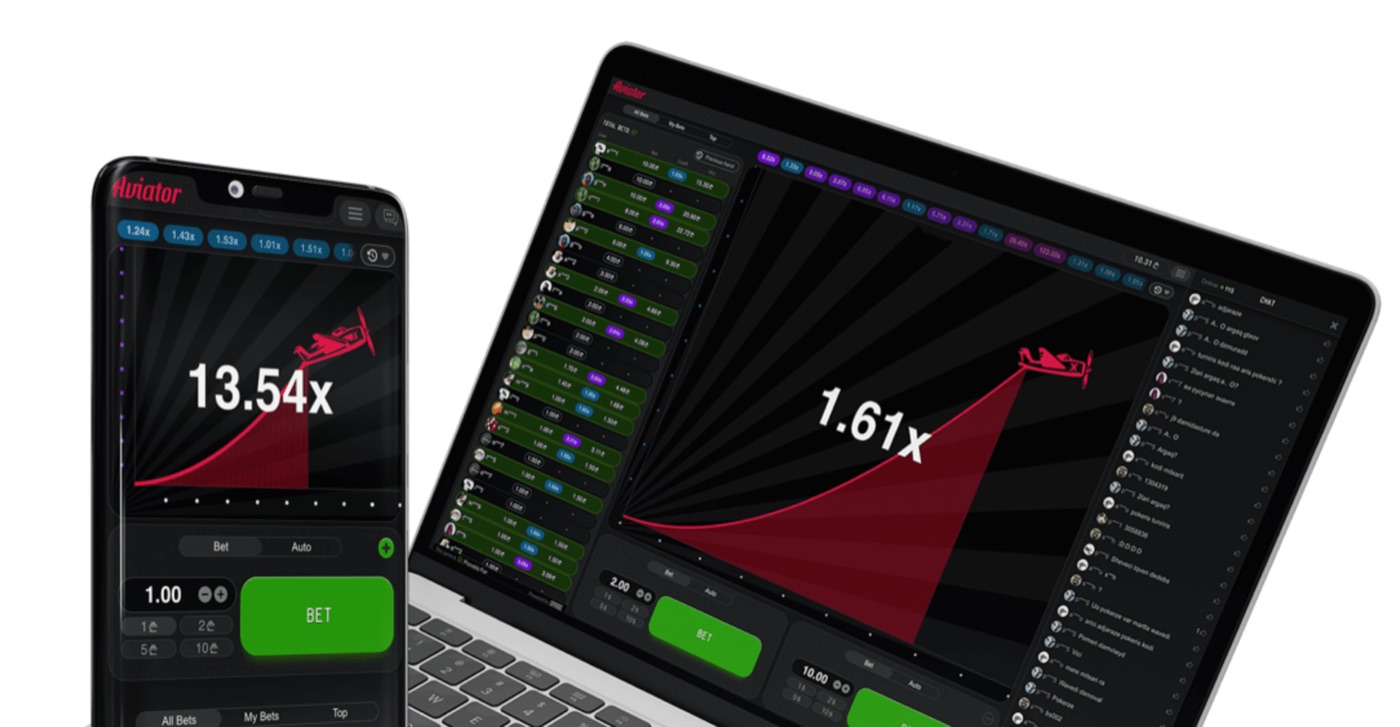
Aviator displays separate multiplier results on mobile and desktop screens.
Round pace and exit
Aviator rounds last about 8–30 seconds, with 60–90 rounds possible in an hour. A few seconds usually separate one round from the next.
The player controls the exit by pressing cash-out before the crash. If the cash-out request reaches the server after the crash, the request does not secure the earlier multiplier.
This creates a different rhythm from a game where the main decision happens before a spin. In Aviator, the player can make a second decision after the round begins:
- Place a stake before take-off.
- Watch the multiplier rise.
- Choose a cash-out point or use Auto Cash-Out.
- Accept the result if the plane crashes after the cash-out.
Two bet panels are available in each round, and each panel can use a separate cash-out. A player could therefore set one panel to exit at a lower multiplier and leave the second panel for a higher target, although the two stakes remain exposed to the same crash point.
The game also includes Auto Bet and Auto Play settings for 10–100 rounds. These tools can repeat a chosen action, but they do not change the 3% house edge or make a target more likely in the next independent round.
- Manual cash-out lets the player choose the exit during the round.
- Auto Cash-Out uses a preset multiplier.
- Auto Bet can repeat stakes across selected rounds.
- Stop-on-win and stop-on-loss can end an automated run.
Connection speed matters to the timing of a cash-out request. Aviator is built for low bandwidth and budget devices, but a slow device or latency can still cause a request to time out.

Aviator appears inside an operator’s mobile casino lobby.
RTP and crash odds
Aviator has a published RTP of 97% and a house edge of 3%. The expected value is minus 3% of the stake at every cash-out target.
The 97% RTP does not mean that every short session returns 97% of the money staked. It describes the long-run mathematical expectation, while individual rounds can produce very different results because Aviator is a high-variance game.
| Crash multiplier target | Probability the round reaches it |
|---|---|
| 1.2x | 80.8% |
| 1.5x | 64.7% |
| 2x | 48.5% |
| 3x | 32.3% |
| 5x | 19.4% |
| 10x | 9.7% |
| 20x | 4.85% |
| 50x | 1.94% |
| 100x | 0.97% |
The probability formula is 0.97 divided by the target multiplier. About 3% of rounds, or roughly 1 in 33, crash instantly at 1.00x.
For example, a player who stakes $10 and cashes out at 2x receives $20 when the round reaches 2x and the request arrives in time. The probability of reaching 2x is 48.5%, but the 3% edge remains in the expected value of that target.
Changing the cash-out point changes variance, not the edge. A lower target can be reached more often, while a higher target occurs less often, but neither choice removes the mathematical disadvantage.
- Aviator RTP: 97%.
- Aviator house edge: 3%.
- JetX RTP: 96.2%–98.9%.
- Spaceman RTP: 95.5%.
- Aviatrix RTP: 97%.
- Aviamasters RTP: 97%.
These figures allow a comparison with named crash games, not with every slot machine. For a broader gambling comparison involving a crash game, multiplier, cash-out, stake, bookmaker, RTP, free bets, or deposit, readers may also encounter aviator 3 entradas in search results; the link does not change the figures or the game rules described here.
Responsible gambling means setting a loss limit before play and stopping when that limit is reached. A target multiplier is not a method for recovering earlier losses.
Independent round results
Aviator fixes the crash point before take-off through its provably fair system. Before each round, the server publishes a SHA-256 hash of the server seed.
Player client seeds are combined with the server seed, and the inputs are revealed after the round. The verification tool inside the game allows the published result to be checked.
This process matters when comparing Aviator with any game whose result is generated separately for each play. It does not make a winning result more likely, but it provides a way to examine whether the stated crash point matches the committed data.
- The server publishes a hash before the round.
- Client seeds from players are combined with the server seed.
- The crash point is fixed before take-off.
- The round ends at the fixed crash point.
- The inputs become available for checking after the round.
Neither Spribe nor the operator can change the result after the round starts. The system also means that a previous multiplier cannot predict the next one.
A run of low multipliers does not create a reason to expect a high multiplier. The same applies to a previous high result. Rounds are independent, so graph analysis, pattern claims, strategy charts, and “best time” claims do not change the odds.
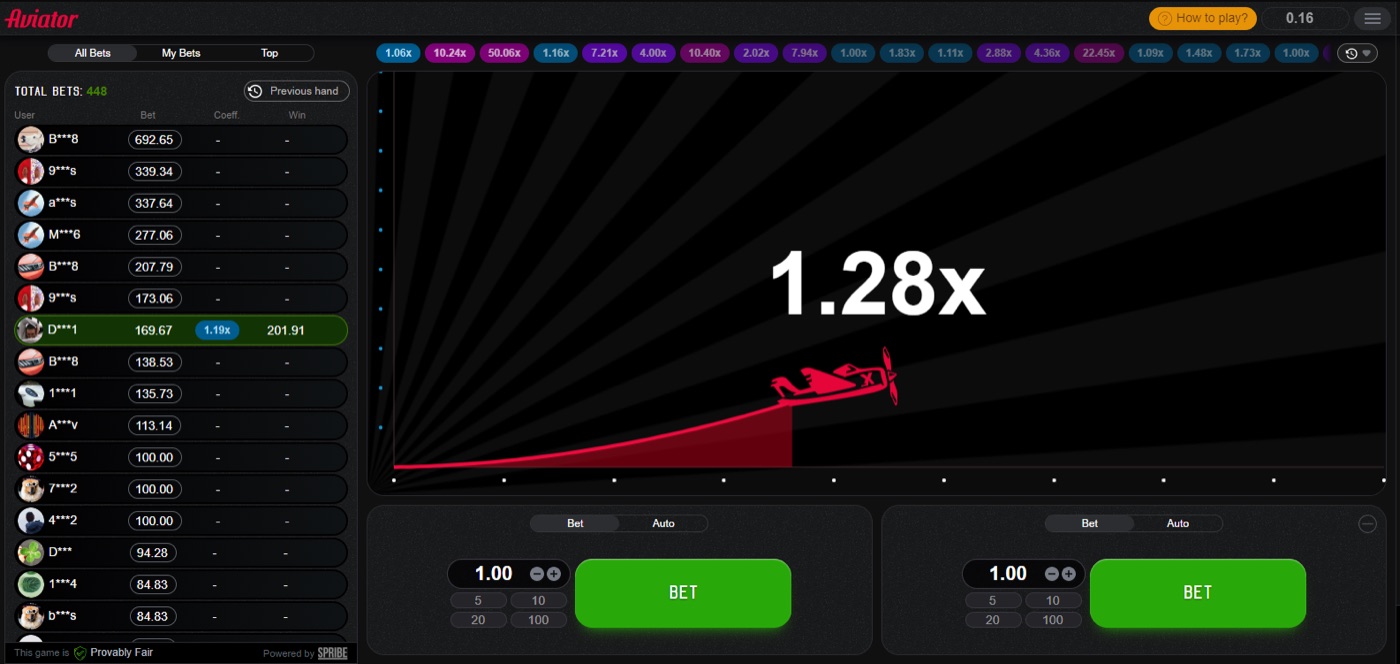
The Aviator screen shows the plane moving while the multiplier increases.
Interface and betting choices
Aviator offers two bet panels in each round, and the interface includes Bet and Auto tabs. The live bets panel shows All Bets, My Bets, and Top views.
The game also displays previous multipliers in the round-history area. These records describe earlier rounds, but they do not alter the probability of the current round.
The available controls support several ways to manage a stake:
- Use one or two bet panels.
- Choose a manual cash-out.
- Set an Auto Cash-Out multiplier.
- Use Auto Bet or Auto Play for 10–100 rounds.
- Apply stop-on-win or stop-on-loss settings.
Typical quick-stake buttons make entry faster, while in-game chat lets players see messages and certain operator announcements. The interface also includes a Provably Fair badge and a live view of selected bets.
Aviator has a demo mode that needs no registration. It works on desktop, tablet, and mobile browsers, which allows a player to inspect the controls without placing a real stake.
There is no standalone official Aviator app from Spribe. The game runs inside an operator’s website or app, while apps using names such as “Aviator Predictor” are third-party products and cannot predict the committed crash point.
- Demo mode allows practice without registration.
- The game works on desktop, tablet, and mobile browsers.
- There is no standalone official Spribe Aviator app.
- Predictor apps and signal bots do not know the future crash point.
Typical stakes range from about $0.10 to $100 per bet, but the available stake range depends on the operator. Win caps per round also depend on the operator, and Spribe does not publish a maximum multiplier.
Strategies and variance
Aviator guides commonly discuss Auto Cash-Out targets between 1.5x and 2x. The probability table shows that 1.5x is reached in 64.7% of rounds and 2x in 48.5%.
These figures describe frequency, not profit. A target can win often and still face the 3% house edge across repeated play.
Another discussed approach splits the stake between two bets. One bet may cash out at 1.5x–2x, while the other aims at 5x–10x, but the second target has a lower probability of being reached.
Guides also suggest keeping a stake at no more than 2% of the bankroll per round and setting win and loss limits. These controls limit exposure; they do not improve RTP.
- Targets of 1.3x–1.5x win in roughly 65%–75% of rounds.
- Longer targets of 5x–50x occur less often.
- Martingale doubles the stake after each loss.
- Ten Martingale losses can require 1,024x the base stake.
- Fibonacci and D’Alembert systems do not beat the 3% edge.
Martingale, Fibonacci, and D’Alembert systems change the size and timing of stakes, not the underlying result distribution. A player can use a lower target, split bets, or automated settings, but each choice changes variance rather than the house edge.
Aviator FAQ
Aviator has a 97% RTP and rounds of about 8–30 seconds. The game uses a player-controlled cash-out rather than a bonus round.
The following answers address the main differences between Aviator and slot machines using the stated game mechanics and figures.
Is Aviator a slot machine?
No. Spribe classifies Aviator as a crash game and instant game. It uses an increasing curve, a possible crash, and a cash-out decision, and it has no bonus round.
Can players cash out whenever they want?
Players can request a cash-out while the multiplier is rising, either manually or through Auto Cash-Out. The request must reach the server before the crash, so latency or a slow device can cause a time-out.
What is Aviator’s RTP?
Aviator’s RTP is 97%, with a 3% house edge. The expected value is minus 3% of the stake at every cash-out target, while individual results vary because the game has high variance.
Can a predictor find the next multiplier?
No. The crash point is fixed before take-off through the provably fair process. Previous multipliers, predictor apps, Telegram bots, and pattern claims cannot predict the next independent result.
Can Aviator be played for free?
Yes. Aviator has a demo mode that needs no registration and works on desktop, tablet, and mobile browsers. Demo play does not use a real stake.
Does a higher cash-out target improve the odds?
No. A 2x target is reached in 48.5% of rounds, while a 10x target is reached in 9.7%. A higher target changes the possible return and variance, but it does not remove the 3% house edge.